




























Historic Find: Archaeologists Discover 13,500-Year-Old Human Settlement in Nefud Desert
Archaeologists discover 13,500-year-old human settlement in Saudi Arabia's Nefud Desert. Natufian-era tools, obsidian trade links, and rock art reveal advanced hunter-gatherer societies.

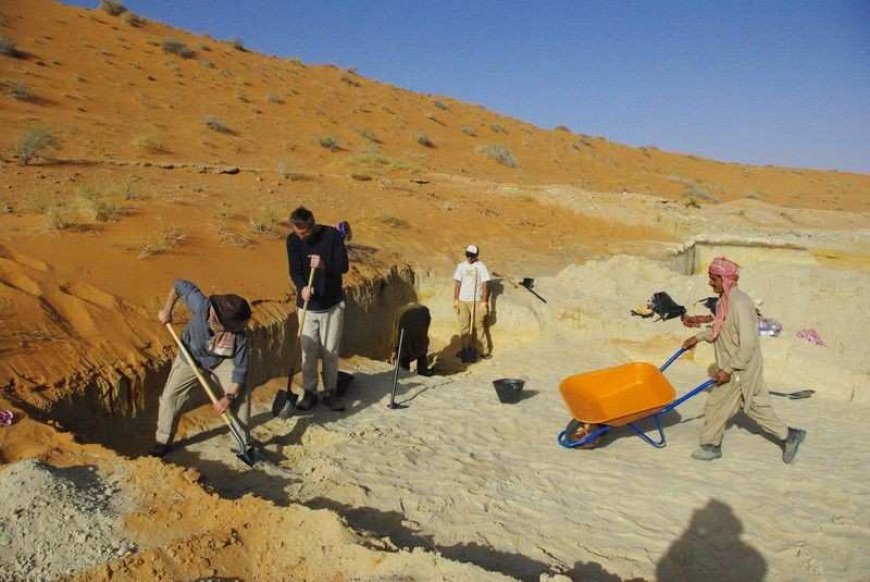
13,500-Year-Old Human Settlement Discovered in Saudi Arabia's Nefud Desert
Riyadh, Saudi Arabia — Archaeologists in Saudi Arabia have uncovered evidence of a human settlement dating back around 13,500 years, offering new insight into how early communities lived and adapted to harsh desert environments. The discovery, announced by the country's Heritage Commission, highlights the presence of advanced hunter-gatherer societies in northern Arabia during the late Ice Age.
The findings were revealed in a scientific study published in the journal Nature titled “The Natufian Epipalaeolithic and Pre-Pottery Neolithic in the desert of northern Arabia.” Researchers say the study provides important evidence about early human migration, cultural development, and long-distance trade networks in the region.
The ancient settlement was identified at the Sahout archaeological site, located on the southern edge of the Nefud Desert between the Arnan and Al-Misma mountains. The area's strategic position suggests it may have served as a link between desert environments and settlement networks connected to the Levant.
Excavations at the site uncovered numerous stone tools, including finely crafted bladelets and arrowheads used for hunting. These tools closely resemble artifacts associated with the Natufian culture, a prehistoric community known for its sophisticated stone-tool technology and semi-sedentary lifestyle.
One of the most significant discoveries was a distinctive type of arrowhead known as Abu Salem points. Scientists conducted geochemical analysis on the obsidian used in the tools and found that the material originated from Jabal Al Abyad, located about 190 kilometres away from the excavation site.
This suggests that prehistoric communities either travelled long distances or maintained trade networks to obtain valuable resources. Researchers believe such exchanges indicate a high level of organisation and interaction among early human groups in the Arabian Peninsula.
The study also uncovered tools used for carving rock art along with archaeological layers containing artistic elements. Among the carvings were large images of camels and human figures, indicating that artistic expression was already an integral part of life in these early societies.
Experts say the discoveries help establish a clearer timeline for cultural activities in prehistoric Arabia, suggesting that art, hunting technology, and social networks were interconnected aspects of early human life.
Researchers believe the findings challenge earlier assumptions that the deserts of northern Arabia were largely uninhabitable during the late Ice Age. Instead, the evidence suggests that early humans successfully adapted to the region's environment and used it as a corridor for migration and cultural exchange.
Saudi Arabia's Heritage Commission said the discovery reflects the Kingdom's commitment to preserving its archaeological heritage and advancing research into the ancient history of the Arabian Peninsula. The study also highlights the region's importance in understanding the early development of human civilisation and movement across the Middle East.
13,500-year-old settlement found in Saudi Arabia: Natufian tools, obsidian trade, and rock art rewrite history of the Arabian Peninsula.