















Saudi Space Economy to Hit $31.6bn by 2035
A new report projects Saudi Arabia's space economy will nearly quadruple by 2035, driven by AI, climate monitoring and record digital adoption.

Report Charts a Fourfold Leap for Saudi Arabia's Space Sector
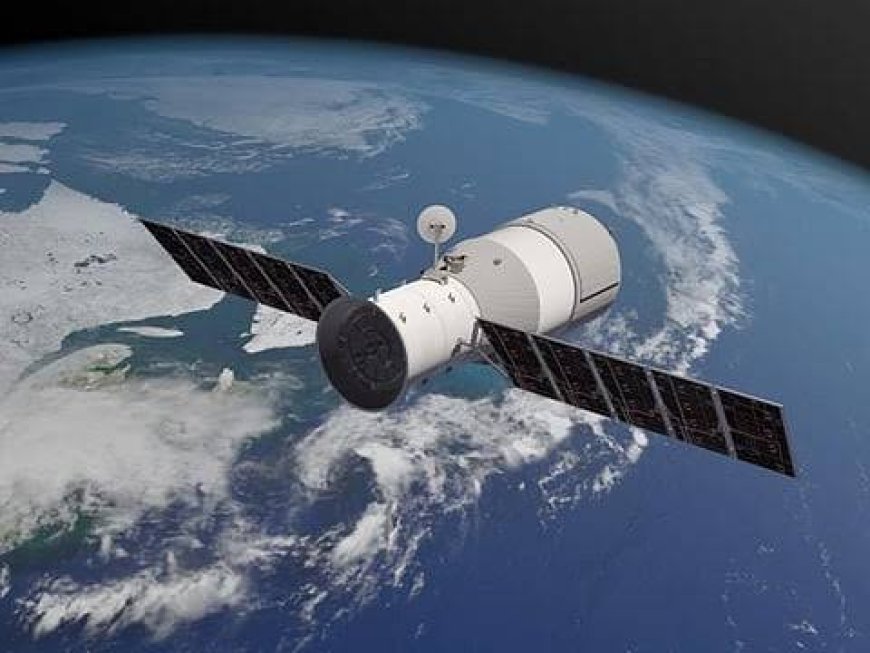
Saudi Arabia's space economy is projected to expand nearly fourfold over the next decade, growing from  31.6 billion by 2035, according to a new report that positions space and digital technology as central pillars of the Kingdom's economic diversification strategy.
The figures come from the Digital & Space Sustainability Report 2026, published by the Communications, Space and Technology Commission with support from the International Telecommunication Union. The report's timing is notable: it arrives as Saudi Arabia works to translate earlier space ambitions into measurable economic output, building on a previous forecast that projected the sector would grow at a compound annual rate of around 12 percent through 2035.
Space as a Climate Tool, Not Just an Industry
Unlike many space-economy reports that focus purely on launch capacity or satellite manufacturing, this one places heavy emphasis on space technology's role in addressing climate and environmental challenges. According to the report, more than half of the essential variables scientists use to track climate change can be measured from space, a statistic that underpins the Kingdom's push to use satellite data for climate monitoring, water management, agricultural planning, desertification tracking and disaster response.
Abdullah Al-Swaha, Minister of Communications and Information Technology, framed the strategy in broad terms, stating that Saudi Arabia is committed to unlocking the potential of artificial intelligence and digital innovation as tools capable of strengthening economies, empowering people and protecting the environment.
A Digitally Connected Kingdom
The report's data points to a country whose digital infrastructure has scaled rapidly. Internet penetration in Saudi Arabia reached 99.6 percent in 2025, placing it among the most connected nations on Earth, while fiber-optic coverage now extends to more than 3.9 million homes. On the ITU's 2025 ICT Development Index, Saudi Arabia posted a score of 99.2 — the highest of any country measured globally.
Artificial intelligence adoption is climbing just as quickly. A separate report from the General Authority for Statistics, released in June, found that AI adoption among Saudi businesses rose to 33.1 percent in 2025, a jump of roughly 20 percent from the year before, as more companies integrate AI tools into their operations.
Progress on Gender Participation
Among the more striking figures in the report is the growth in women's participation in the Kingdom's digital sector, which climbed to 35 percent — the highest rate in the Middle East and North Africa region, and above both G20 and European Union averages. That figure represents a dramatic rise from just 7 percent in 2018, reflecting broader labor-market reforms that have accompanied Saudi Arabia's Vision 2030 agenda.
Digital Economy's Growing Weight in GDP
The report also quantifies the digital economy's direct contribution to national output, estimating that it accounted for 15 percent of Saudi Arabia's gross domestic product in 2024, equivalent to roughly SR459 billion, or about $122.4 billion. That makes Saudi Arabia's information and communications technology market the largest in the region by the report's measure.
The Kingdom's international recognition in the sector has been building for years. Since 2012, Saudi Arabia has won 16 World Summit on the Information Society awards and 47 certificates of excellence, the highest tally of any country in the region — a track record officials point to as evidence that the Kingdom's digital strategy predates the current AI boom rather than simply riding its coattails.
Environmental Gains Feed the Same Strategy
The report ties these technology gains directly to the Saudi Green Initiative, which has launched more than 85 environmental programs since 2021, ten of which are now fully completed. Achievements cited include the rehabilitation of one million hectares of land, the connection of more than 3.6 gigawatts of renewable energy to the national grid, the planting of over 161 million trees, and the protection of 18.1 percent of the Kingdom's terrestrial areas and 16.1 percent of its marine areas. More than 10,000 wild animals have also been released into nature reserves and national parks as part of the same broader push.
The initiative's longer-term targets are ambitious: net-zero emissions by 2060, a reduction of 278 million tonnes of emissions annually by 2030, and formal protection of 30 percent of the Kingdom's land and marine territory by the same year.
A Strategy Built on Convergence
Taken as a whole, the report frames Saudi Arabia's space and digital strategy not as a standalone technology bet, but as an integrated approach in which satellite data, AI infrastructure and environmental policy reinforce one another. If the $31.6 billion projection holds, the space economy alone would represent a meaningful new pillar of non-oil GDP by the mid-2030s — one that officials argue is inseparable from the Kingdom's parallel push toward sustainability and climate resilience.