






























Groundbreaking Find: Ancient Footprints in Nefud Desert Reveal Shocking Human Migration Clues
Archaeologists have discovered 120,000-year-old human footprints in Saudi Arabia’s Nefud Desert, offering rare evidence of early human migration across the Arabian Peninsula.

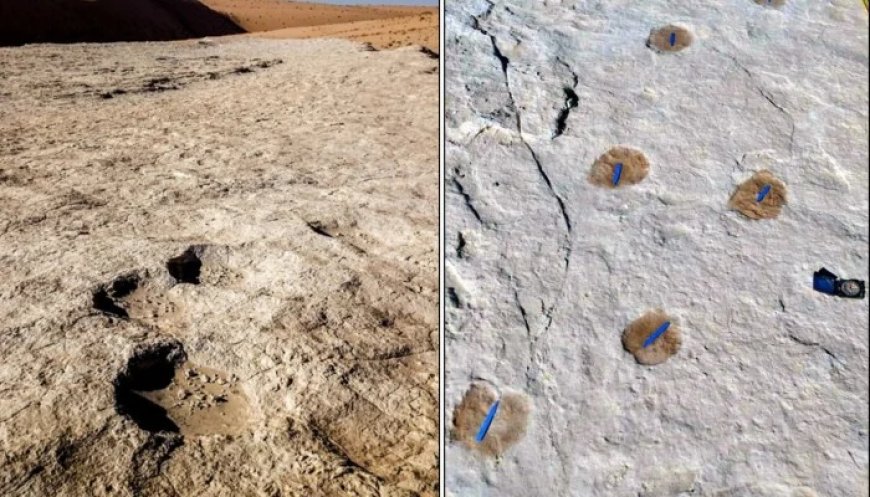
120,000-Year-Old Human Footprints Found in Saudi Arabia’s Nefud Desert Rewrite Migration History
Archaeologists have made a remarkable discovery in Saudi Arabia that is reshaping our understanding of early human history. Scientists have uncovered fossilised human footprints dating back around 120,000 years in the Nefud Desert, offering rare and direct evidence of where ancient humans once walked.
The footprints were found at a site known as Alathar, which was once an ancient lake. Researchers believe this location served as a temporary stop for early humans and animals in search of water. The findings, published in the journal Science Advances, are considered the oldest known traces of Homo sapiens on the Arabian Peninsula, pushing back the timeline of human presence in the region significantly.
What makes this discovery particularly significant is that footprints provide a more immediate snapshot of life compared to tools or bones. Unlike other archaeological remains, these impressions capture a moment in time—revealing how ancient humans moved across the landscape and interacted with their surroundings. The tracks suggest that a small group of humans passed through the area, likely stopping briefly at the lake before continuing their journey.
The site also contained numerous footprints of large prehistoric animals, including elephants, camels, and other species that once roamed the region. This indicates that humans and wildlife coexisted in the area, likely gathering around water sources that were crucial for survival. Scientists believe the lake acted as a natural meeting point, drawing both humans and animals during dry periods.
Interestingly, researchers found little evidence of long-term human settlement at the site. There were no tools or signs of hunting activity, suggesting that the humans who left the footprints were not living there permanently. Instead, the area appears to have been a temporary stopover, possibly part of a larger migration route. The absence of artifacts points to a transient presence.
The discovery also supports the “Green Arabia” theory, which proposes that the Arabian Peninsula was not always a desert. Around 120,000 years ago, the region experienced periods of increased rainfall, transforming it into a greener, more habitable environment with lakes, grasslands, and abundant wildlife. These favourable conditions would have made it easier for early humans to travel through and settle in the region.
Perhaps most importantly, the findings challenge traditional views of human migration. For decades, scientists believed that humans migrated out of Africa in a single major wave around 60,000 years ago. However, the Alathar footprints suggest that humans may have left Africa much earlier in smaller groups, taking multiple routes and spreading across different regions over time. This discovery adds a new chapter to the story of human dispersal.
The footprints were dated using advanced scientific techniques, including optically stimulated luminescence (OSL), which helps determine when sediments were last exposed to sunlight. This method allowed researchers to establish a reliable timeline for the site and confirm its ancient origins. The dating process was rigorous and thorough.
Overall, the discovery provides a fascinating glimpse into the lives of early humans and their journeys across prehistoric landscapes. It highlights how changing climates influenced migration patterns and underscores the importance of Arabia as a key corridor in human history. The findings are expected to inspire further research in the region.
Also Read: Protect Your Kidneys: Nephrologist Reveals 6 Essential Daily Habits for Better Health
As researchers continue to study the site, the Alathar footprints are expected to offer even deeper insights into how our ancestors moved, survived, and adapted in a world vastly different from today. The site remains an active area of archaeological investigation. Future excavations may reveal even more secrets about our distant past.