






















Leading Through Transformation: Dr. Mirza Baig on the Future of HR and Leadership in the GCC
Leading Through Transformation: Dr. Mirza Baig on the Future of HR and Leadership in the GCC

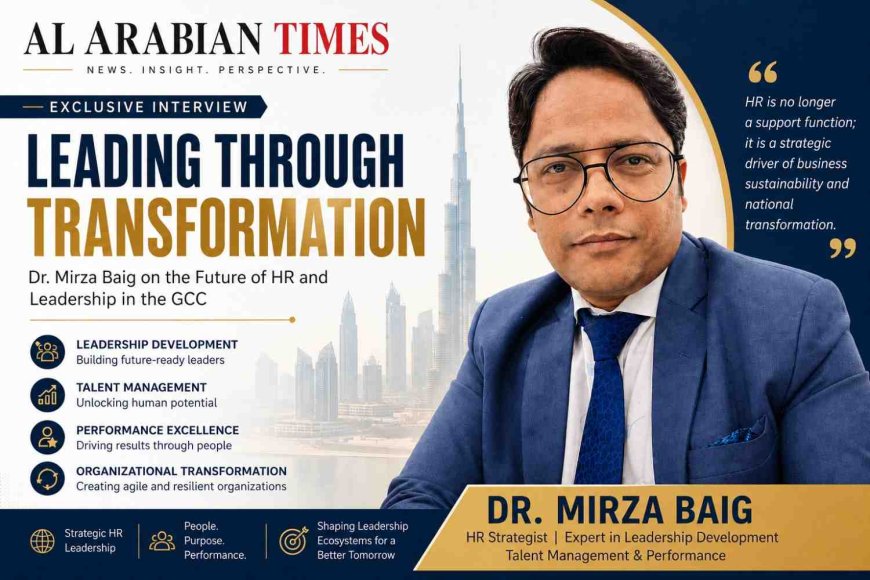
Leading Through Transformation: Dr. Mirza Baig on the Future of HR and Leadership in the GCC
In today’s rapidly evolving business environment, organizations across the GCC are increasingly recognizing that sustainable success is not built solely on systems, technology, or processes, but on people and leadership. As businesses navigate transformation, talent development and leadership capability have emerged as critical priorities, reshaping the role of human resources into a strategic driver of organizational growth.
Among the professionals contributing significantly to this transformation is Dr. Mirza Baig, an experienced HR Strategist with over 24 years of expertise in leadership development, talent management, performance excellence, and organizational transformation across the GCC region. Through years of working across industries and cultures, Dr. Mirza Baig has witnessed firsthand how organizations evolve when leaders genuinely invest in people, succession planning, and employee growth.
Dr. Mirza Baig’s journey into the HR profession was inspired by a deep fascination with people understanding what motivates individuals, how organizations shape cultures, and how leadership can transform businesses as well as lives. Early in his career, he realized that while technology, systems, and strategies are important, sustainable success ultimately depends on people and leadership capability.
Over the last 24 years, particularly within the GCC region, he has observed how organizations progress when leadership remains committed to talent development, succession planning, and empowering employees. That realization inspired him to move beyond transactional HR and focus on strategic human capital transformation.
What continues to inspire him today is the opportunity to influence organizational futures through building leadership pipelines, coaching senior leaders, designing transformation frameworks, and helping organizations create cultures where people feel valued, empowered, and aligned with purpose. For Dr. Mirza Baig, HR is no longer a support function but a strategic driver of business sustainability and national transformation.
Throughout his professional journey, Dr. Mirza Baig has encountered challenges that have shaped his leadership philosophy. One of the biggest challenges in strategic HR, he explains, is balancing business expectations with human realities. In rapidly transforming environments, especially within large organizations, leaders often focus heavily on performance, speed, and transformation, while employees seek stability, clarity, and purpose. Bridging that gap requires empathy, influence, and strategic alignment.
Another major challenge has been driving cultural and mindset transformation. While systems can often be implemented quickly, changing leadership behavior, building accountability, and creating a learning culture requires patience and persistence. During major HR transformation initiatives, he learned that successful change management is less about processes and more about trust, communication, and leadership buy-in.
One of the most important lessons Dr. Mirza Baig has learned over the years is that leadership is not about authority, but about impact. According to him, the most successful HR leaders are those who listen actively, build credibility through consistency, and influence business outcomes through people-centric strategies. He also believes resilience is essential, emphasizing that transformation journeys are rarely linear, but when the vision is clear and people remain at the center, long-term results follow.
From his perspective, the HR and leadership landscape across the Arab world, particularly within the GCC, is evolving at an unprecedented pace. Governments and organizations are no longer viewing HR as merely an administrative function. Instead, it is increasingly becoming a strategic pillar driving economic diversification, innovation, and workforce sustainability.
He points to initiatives such as Saudi Vision 2030 as a major catalyst accelerating leadership development, digital transformation, localization strategies, and talent capability building. Organizations, he notes, are increasingly investing in succession planning, executive coaching, women leadership initiatives, employee experience, and future skills development.
Looking ahead, Dr. Mirza Baig believes the region will experience several major transformations in the years to come. He anticipates a stronger shift toward skills-based organizations rather than purely role-based structures, increased adoption of AI-driven HR analytics and intelligent talent platforms, greater focus on leadership agility, emotional intelligence, and adaptive leadership, expansion of internal talent marketplaces and career mobility frameworks, and a higher emphasis on employee wellbeing, purpose, and culture as strategic differentiators.
According to him, the future HR leader in the GCC will need to combine business acumen, digital fluency, and human-centered leadership. Organizations that succeed will be those capable of creating cultures centered around continuous learning, innovation, and inclusion.
Reflecting on what initially motivated him to pursue a career in HR, Dr. Mirza Baig shares that the opportunity to make a meaningful impact on people’s professional lives was one of the strongest drivers. He has always believed that careers, leadership, and workplace culture can significantly shape an individual’s confidence, growth, and sense of purpose.
As his career progressed, he developed a growing passion for organizational development, leadership capability building, and helping businesses unlock human potential. Witnessing leaders grow, teams transform, and employees succeed has remained deeply fulfilling throughout his journey. HR, for him, provided the unique opportunity to combine strategy with human connection, a balance that continues to motivate him every day.
A typical day for Dr. Mirza Baig rarely follows a predictable routine. He describes strategic HR leadership as dynamic, with no two days being the same. His day often involves engaging with senior leaders on talent and business priorities, reviewing leadership development initiatives, discussing succession pipelines, coaching managers, and aligning organizational capability strategies with broader business objectives.
In addition, he spends considerable time mentoring teams, facilitating talent discussions, reviewing workforce analytics, and contributing to transformation initiatives aimed at improving employee experience and organizational effectiveness. At the same time, he intentionally creates space for conversations across all levels of an organization, believing that valuable leadership insights often emerge through informal interactions rather than solely within boardroom discussions.
Leadership in the GCC, Dr. Mirza Baig observes, is undergoing a significant transformation. Traditionally, leadership models in the region were more hierarchical and directive. However, today’s workforce, particularly younger generations, increasingly expects leaders to be collaborative, empowering, agile, and purpose-driven.
In the current environment, he believes adaptive and transformational leadership styles are essential. Modern leaders, according to him, must balance business performance with empathy, innovation, and people development. The most effective leaders are those who inspire trust during uncertainty, create psychological safety, embrace diversity of thought, and continuously evolve while guiding organizational transformation. Leadership today, he emphasizes, is less about control and more about influence, empowerment, and creating sustainable impact.
When describing his own leadership approach, Dr. Mirza Baig characterizes it as collaborative, transformational, and people-centric. He strongly believes in empowering individuals, creating clarity of purpose, and building environments where people feel trusted and motivated to contribute their best. His approach emphasizes coaching, capability development, and helping teams connect their work to broader organizational goals.
At the same time, he maintains that leaders must remain decisive and accountable. While empathy is important, maintaining performance standards and strategic direction is equally essential. Over the years, he has learned that effective leadership requires adapting one’s approach based on people, situations, and organizational needs, while remaining authentic and values-driven.
Among the more complex professional challenges Dr. Mirza Baig has overcome are leading transformation initiatives during periods of organizational change marked by resistance, uncertainty, and shifting business priorities. In such circumstances, he focused heavily on stakeholder engagement, transparent communication, and aligning people strategies with business realities. Rather than forcing change, he prioritized creating understanding and involvement among leadership teams and employees alike.
He also highlights the challenge of balancing rapid transformation with capability readiness. While organizations often seek immediate outcomes, sustainable transformation, he believes, requires meaningful investment in leadership capability, culture, and employee engagement. Ultimately, he has learned that transformation succeeds when people feel included in the journey rather than merely impacted by it.
On the growing role of artificial intelligence and emerging technologies, Dr. Mirza Baig believes AI and digital innovation are fundamentally reshaping how organizations operate, make decisions, and engage talent. Within HR specifically, AI is helping organizations improve workforce planning, predictive analytics, talent acquisition, learning personalization, and employee experience.
However, he strongly believes technology should enhance human decision-making rather than replace human judgment. While AI can provide valuable insights, empathy, ethical leadership, emotional intelligence, and genuine human connection remain irreplaceable. In his view, the future belongs to organizations capable of successfully combining technology with humanity.
He also believes HR leaders play a critical role in preparing organizations for the future of work through building digital readiness, reskilling talent, and helping leaders adapt to rapidly changing business environments.
Looking toward the future, Dr. Mirza Baig’s long-term goal is to continue contributing toward building future-ready organizations and leadership ecosystems across the GCC and the broader Arab region. He aspires to play a meaningful role in shaping strategic talent frameworks, leadership capability models, succession ecosystems, and transformation initiatives that support both organizational growth and national development agendas.
He is also passionate about mentoring emerging leaders and contributing thought leadership around culturally aligned leadership models within the Arab context. Dr. Mirza Baig believes the region has a unique opportunity to redefine leadership by integrating global best practices with local cultural values and strategic priorities.
Ultimately, he hopes his contribution will be remembered not only through systems or frameworks, but through the leaders, teams, and organizations that became stronger, more resilient, and more human-centered through the work accomplished together.